The Targa Florio was
an open road endurance automobile race held in the mountains of
Sicily near Palermo. Founded in 1906, it was the oldest sports car
racing event, part of the World Sportscar Championship between 1955
and 1973. While the first races consisted of a whole tour of the
island, the track length in the race's last decades was limited to
the 72 kilometres (45 mi) of the Circuito Piccolo delle Madonie,
which was lapped 11 times.
After 1973, it was a
national sports car event until it was discontinued in 1977 due to
safety concerns. It has since been run as a rallying event, and is
part of the Italian Rally Championship.

Porsche 908 passing Colessano
The race was created
in 1906 by the wealthy pioneer race driver and automobile enthusiast,
Vincenzo Florio, who had started the Coppa Florio race in Brescia,
Lombardy in 1900.
One of the toughest
competitions in Europe, the first Targa Florio covered 3 laps
equalling 277 miles (446 km) through multiple hairpin curves on
treacherous mountain roads, at heights where severe changes in
climate frequently occurred. Alessandro Cagno won the inaugural 1906
race in nine hours, averaging 30 miles per hour (50 km/h).
By the mid-1920s,
the Targa Florio had become one of Europe's most important races, as
neither the 24 Hours of Le Mans nor the Mille Miglia had been
established yet. Grand Prix races were still isolated events, not a
series like today's F1.
The wins of Mercedes
(not yet merged with Benz) in the 1920s made a big impression in
Germany, especially that of German Christian Werner in 1924, as he
was the first non-Italian winner since 1920. Rudolf Caracciola
repeated a similar upset win at the Mille Miglia a couple of years
later. In 1926, Eliska Junkova, one of the great female drivers in
Grand Prix motor racing history, became the first woman to ever
compete in the race.
In 1953, the FIA
World Sportscar Championship was introduced. The Targa became part of
it in 1955, when Mercedes had to win 1-2 with the Mercedes-Benz 300
SLR in order to beat Ferrari for the title. They had missed the first
two of the 6 events, Buenos Aires and the 12 Hours of Sebring, where
Ferrari, Jaguar, Maserati and Porsche scored. Mercedes appeared at
and won in the Mille Miglia, then pulled out of Le Mans as a sign of
respect for the victims of the 1955 Le Mans disaster, but won the
Tourist Trophy at Dundrod. Stirling Moss/Peter Collins and Juan
Manuel Fangio/Karl Kling finished minutes ahead of the best Ferrari
and secured the title.

Several versions of
the track were used. It started with a single lap of a 148 km (92 mi)
circuit from 1906-1911 and 1931. From 1912 to 1914 a tour around the
perimeter of Sicily was used, with a single lap of 975 kilometres
(606 mi), lengthened to 1,080 kilometres (670 mi) from 1948 to 1950.
The 148 km "Grande" circuit was then shortened twice, the
first time to 108 km (67 mi), the version used from 1919-1930, and
then to the 72 km (45 mi) circuit used from 1932 to 1936 and 1951 to
1977. From 1951-1958, the long coastal island tour variant was used
for a separate event called the Giro di Sicilia (Lap of Sicily).
The start and finish
took place at Cerda. The counter-clockwise lap lead from Caltavuturo
and Collesano from an altitude over 600 metres (1,970 ft) down to sea
level, where the cars raced from Campofelice di Roccella on the
Buonfornello straight along the coast, a straight over 6 km (3.7 mi)
longer than the Mulsanne Straight at the Circuit de la Sarthe in Le
Mans. The longest version of the circuit went south through
Caltavuturo (whereas the shortest version of the open-road circuit
went east just before entry into Caltavuturo, through a mountainous
section directly to Collesano) through an extended route through
elevation changes, and swept through the nearby towns of Castellana
and Sottana, twisting around mountains up to the town of Castelbuono
and rejoined the most recent version of the track at Collesano. The
second version of the track also went south through Caltavuturo and
took a shortcut starting right before Castellana to Collesano via the
town of Polizzi Generosa. There was a closed circuit called Favorita
Park used from 1937-1940.
The challenge of the
Targa was unprecedented in its difficulty and the driving experience
of any of the course variants was unlike any other circuit in the
world other than perhaps that of the Nurburgring in Germany. The
original Grande 148 km (92 mi) circuit had in the realm of 2,000
corners per lap, the 108 km (67 mi) Medio had about 1,300-1,400
corners per lap and the final iteration of the course, the 72 km (45
mi) Piccolo circuit had about 800-900 corners per lap. To put that in
perspective, most purpose built circuits have between 12 to 18
corners, and the longest purpose built circuit in the world, the
13-mile Nurburgring, has about 180 corners. So learning any of the
Targa Florio courses was extremely difficult and required, like most
long circuits, at least 60 laps to learn the course- and unlike the
purpose-built Nurburgring, the course had to be learned properly in
public traffic, and one lap would take about an hour to do in a road
car- if there was little to no traffic.

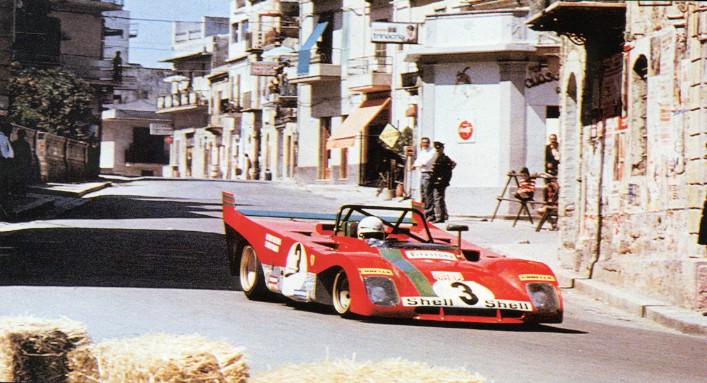
In the late 1960s
and early 1970s, race cars with up to 600 hp (450 kW) such as Nino
Vaccarella's Ferrari 512S raced through small mountain villages while
spectators sat or stood right next to, or even on, the road. Porsche,
on the other hand, did not race its big Porsche 917, but rather the
nimble Porsche 908/03 Spyders.
Due to safety
concerns, especially by Helmut Marko, who called the race "totally
insane", the last Targa Florio as a World Sportscar Championship
race was run in 1973; where during this event it became impossible to
retain its international status after a number of horrendous and 2
fatal accidents at the event; one which privateer Charles Blyth
crashed his Lancia Fulvia HF into a trailer at the end of the
Buonfornello straight and was killed; and another where an Italian
driver crashed his Alpine-Renault into a group of spectators, killing
one. There were several other accidents during practice for the 1973
event in which a total of seven spectators sustained injuries. In
that year, even a Porsche 911 won as the prototypes such as Jacky
Ickx's Ferrari suffered crashes or other troubles. Another reason for
the Targa's international demise was because international automotive
governing body, the FIA, mandated safety walls on all circuits that
were going to hold FIA-mandated events; and the 44-mile length of
combined public roads made this simply impossible and totally
impractical, especially from a financial standpoint. The Targa was
continued as a national event for some years, before a crash in 1977
which killed 2 spectators and seriously injured 5 others (including
the driver) sealed its fate. The 1977 race was forcibly taken over by
local police and was stopped on the 4th lap, and it also saw 2 other
drivers having serious accidents; one of them was critically injured,
but survived.
Although the Targa
Florio was a rally-type race that took place on closed-off Sicilian
public mountain roads with (aside from straw bales and weak
guardrails at some of the turns, the latter were installed by the
island's government) practically no safety features, only 9 people-
including spectators- died at the event over the 71 year and 61 race
history using a total of 6 circuit configurations. This amount is
relatively small compared to other open road races, like the Mille
Miglia, where over a period of 30 years and 24 races, 56 people lost
their lives and the Carrera Panamericana, where over a period of 5
years and 5 races, 25 people were killed. This is probably due to the
fact that the mountain roads were extremely twisty and average speeds
never reached even 80 mph even up to the final years of the race's
history, even with the very long straight at the northernmost of the
track.

No hay comentarios:
Publicar un comentario